 Stakedao
 - Voting Power Behind DeFi Yield
Stakedao uses pooled, locked governance tokens to boost rewards for liquidity providers. The DeFi platform’s Liquid Lockers issue tradable sdTokens, and Strategies use the accumulated voting power to improve rewards on supported liquidity positions. Lending makes selected strategy positions usable as collateral, allowing borrowing while the underlying assets continue earning incentives. SDT staking adds protocol governance and fee participation through vlSDT. Votemarket connects gauge votes with incentive campaigns, and the Boost Marketplace lets participants rent additional sdToken voting weight. These products share governance infrastructure, with different assets, reward sources, and exit conditions governing the exposure each position provides.
The short version: An sdToken provides a tradable locker position while its underlying governance token remains locked, making exit prices a separate consideration.
Liquid Lockers and Strategies as Shared Infrastructure
Liquid Lockers supply pooled governance power, Strategies apply that power to liquidity positions, and lending makes selected positions usable as collateral.
Governance Tokens and sdTokens
CRV, FXN, and YB are governance tokens supported by Liquid Lockers, where their locked balances build the system’s voting power. Corresponding sdTokens represent tradable locker positions and support participation in underlying protocol governance through vote replication.
LP Tokens and Gauge Rewards
Strategies accept liquidity provider (LP) tokens representing positions in underlying pools, where a gauge distributes protocol rewards to deposited liquidity. Strategies use the locker’s pooled governance balance to boost those rewards. LP depositors can access this shared boost without personally locking governance tokens. A pool needs an active gauge with allocated weight before a corresponding strategy can be deployed.
Fees Connecting Liquidity and Governance
Strategy performance fees connect LP rewards with the governance infrastructure providing their boost, with charges applied when rewards are harvested.
A portion of strategy fees can flow to sdToken holders whose locker supplies the boost. Allocations can also include vlSDT holders and the DAO treasury, with the split varying by underlying protocol.
Each strategy displays its applicable fee rates, with performance fees calculated on harvested rewards. This model imposes no strategy deposit or withdrawal fee. Pool trading fees and boosted gauge emissions are distinct sources of strategy returns.
Liquid Locker performance fees likewise apply to reward harvests at locker-specific rates, while Curated Vaults have separate curator and infrastructure fee terms. Network transaction costs, conversion costs, and borrowing interest remain separate when those operations are used.
Tradable sdTokens and Permanent Underlying Locks
Liquid Lockers separate the tradable position from the governance tokens underneath it, which remain locked and continuously relocked. An sdToken can trade through decentralized exchange liquidity pools, where its exchange rate responds to market demand. A sale therefore depends on available liquidity and the executable price. Token tradability does not establish a fixed one-for-one exit value or release the underlying governance token. Staking sdTokens for rewards and supplying sdToken liquidity also create different positions, with different sources of earnings.
Borrowing Against Yielding Positions
Lending accepts selected strategy positions as collateral while their rewards continue, subject to the chosen market’s borrowing terms and liquidation threshold.
The integration uses non-transferable wrappers around supported strategy positions. These wrappers connect the collateral to Morpho’s lending infrastructure and track its rewards. Eligibility belongs to the selected market; the existence of a strategy alone does not make its position acceptable collateral.
The loan asset, borrowing limit, and interest terms are market-specific. The debt accrues interest alongside continuing incentives, adding a liability to the LP position’s reward exposure.
A fall in collateral value or growth in debt can trigger liquidation. Market rules determine whether liquidation affects part or all of the position. A liquidator repays debt in the market’s loan asset and receives collateral; the seized amount stops earning rewards for the borrower. The wrapper’s transfer restrictions do not remove this liquidation mechanism.
What Changes the Yield a Strategy Pays?
A strategy’s yield reflects its underlying LP position, gauge emissions, available governance boost, and performance fees. Reward-token prices and deposited liquidity also affect the annualized rate.
OnlyBoost Allocation
OnlyBoost is available only for Curve strategies and distributes eligible LP deposits between Stakedao and Convex using governance balances and Convex’s LP balance to determine the split. This arrangement pools access to boost across providers; it does not establish a fixed return.
Curated Vault Allocation
Curated Vaults add automated compounding and managed allocation, with curators deciding how deposits spread across the strategy infrastructure. The selected vault therefore adds an allocation policy and its provider’s operating terms to the underlying yield exposure. Management decisions, fees, and the assets held all matter when interpreting a vault’s displayed rate.
SDT Staking, vlSDT, and Withdrawal Timing
Active vlSDT stake carries flat governance power: one staked SDT corresponds to one vote, without time decay. vlSDT also amplifies sdToken voting weight.
Protocol-fee eligibility begins with the first full weekly epoch after staking and uses the epoch-start balance. Immediate governance power and fee eligibility therefore follow different timing rules. The vlSDT staking system uses an eight-week withdrawal queue. An unstake request starts that queue for the requested amount; completing withdrawal follows the waiting period.
The older veSDT system no longer accepts new locks, although existing holders retain governance voting rights until lock expiry. veSDT no longer supplies sdToken boost. Migration to vlSDT remains available for existing locks.
Gauge Votes and Rented Boost
Votemarket rewards eligible gauge votes through incentive campaigns, while the Boost Marketplace exchanges temporary delegations of vlSDT boost between participants. Votemarket also supports vote-escrowed protocols outside the SDT ecosystem, with eligibility determined by the supported protocol and campaign.
Campaign managers fund token rewards to attract votes toward selected gauges. Voters’ contributions determine their share of the relevant incentives. Boost Marketplace sellers instead list voting-weight delegation with a weekly price, maximum duration, and payment token. Buyers acquire additional boost for their sdTokens without accumulating the corresponding vlSDT themselves. Delegating boost out reduces the balance available to weight the seller’s sdTokens, while incoming delegation adds to the buyer’s effective boost.
Position Choice and Exit Constraints
The asset held and the access required determine which component fits the task, alongside the specific constraints attached to each position.
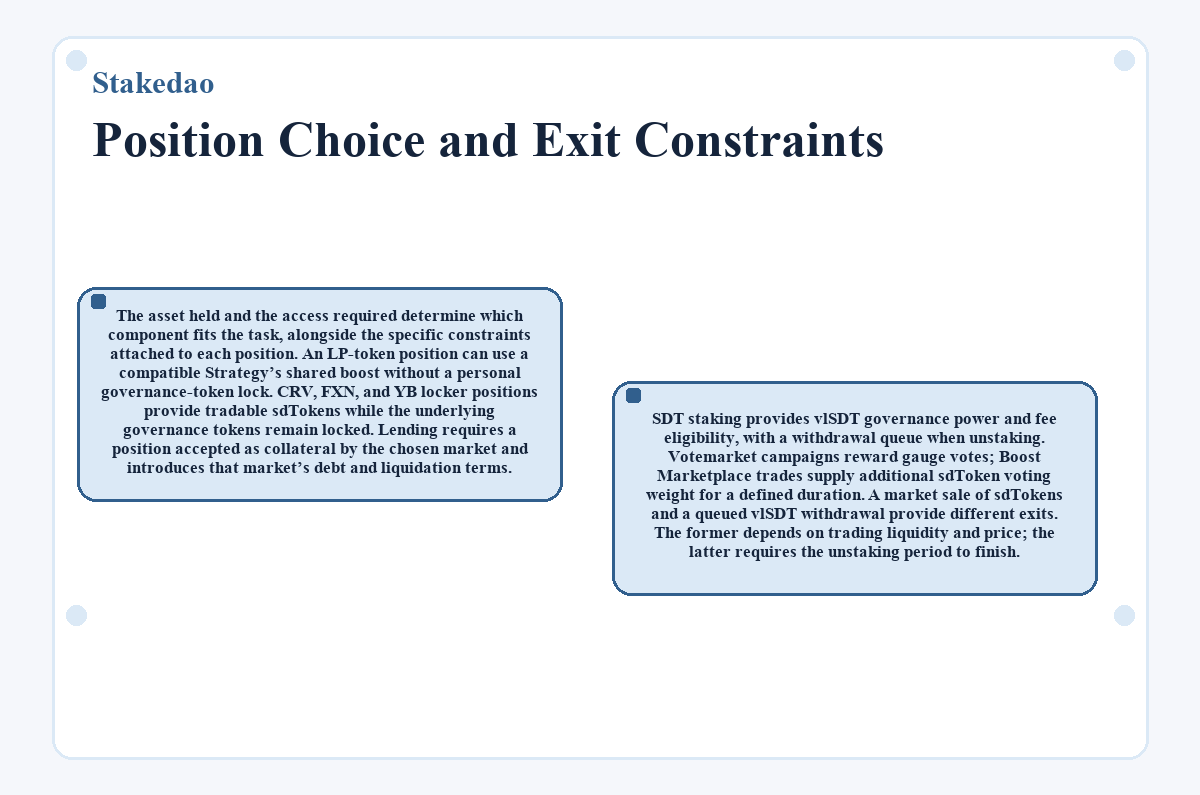
- An LP-token position can use a compatible Strategy’s shared boost without a personal governance-token lock.
- CRV, FXN, and YB locker positions provide tradable sdTokens while the underlying governance tokens remain locked.
- Lending requires a position accepted as collateral by the chosen market and introduces that market’s debt and liquidation terms.
- SDT staking provides vlSDT governance power and fee eligibility, with a withdrawal queue when unstaking.
- Votemarket campaigns reward gauge votes; Boost Marketplace trades supply additional sdToken voting weight for a defined duration.
A market sale of sdTokens and a queued vlSDT withdrawal provide different exits. The former depends on trading liquidity and price; the latter requires the unstaking period to finish.
Details worth knowing about Stakedao
Can I Enter a Strategy With a Single Asset?
Zap can convert a supported starting token into a strategy position without requiring an LP token beforehand. The conversion route has its own price impact, fees, and minimum output. Available routing must support the selected input and destination; a quoted conversion remains subject to its execution conditions.
What Did Staking v2 Change About Reward Accounting?
Staking v2 uses deposit amounts and timing to assign rewards to the depositors who earned them. This accounting addresses an earlier streamed-reward model in which new deposits could dilute rewards accumulated by existing depositors. Withdrawals before distribution could also forfeit the departing depositor’s share of those rewards.
How Does Holding vlSDT Affect My Strategy APR?
A personal vlSDT balance does not directly increase the APR of an LP Strategy position. Strategies share boost at the locker level. Personal vlSDT boost applies to staked sdToken positions, where it changes effective voting weight and associated incentive exposure.
What Happens to Voting Power During a vlSDT Unstake Request?
The amount requested for unstaking immediately stops contributing vlSDT voting power. The remaining active stake keeps its voting weight. A pending request can be cancelled before its waiting period ends, restoring the corresponding voting power.
Why Can a Curated Vault Redemption Remain Pending?
Lagoon-based Curated Vaults use asynchronous redemption requests, so assets become redeemable after processing. A pending request has not reached that stage. Standard IPOR and Morpho vault flows use direct withdrawals. Withdrawal behavior follows the selected infrastructure, so an immediate exit available through one provider does not establish the same timing for another.
Are Strategy Deposits Automatically Insured?
Strategy cover is optional and available only for supported strategies and chains through OpenCover, with Nexus Mutual underwriting the cover. Protection follows the insured strategy, covered events, and policy terms. Ordinary market losses, phishing, and private-key loss are excluded. Claims require eligibility under Nexus Mutual’s terms, including membership and identity checks.
Is vlSDT Required to Vote on Underlying Protocol Proposals?
sdToken holders can participate in underlying protocol governance without holding vlSDT. Vote replication carries their preferences through the Liquid Locker to the relevant protocol. Voting weight uses time-weighted staked balances, so holding tokens briefly does not establish the same influence as sustained staking. This participation is distinct from governance of Stakedao itself.