 Stakedao
 strategies turn shared governance power into boosted LP rewards
Stakedao strategies use Liquid Locker governance balances to increase rewards on deposited liquidity provider tokens. Harvesting brings those rewards into the distribution system, where applicable performance fees reduce the amount available to depositors. The strategy, underlying pool, and reward policy determine how yield accrues and becomes claimable. Only Boost divides Curve strategy deposits between boost providers; Curated Vaults add managed allocation across strategies, with their own fees and settlement rules.
Bottom line: A fee-adjusted APR already includes its modeled protocol charges, so deducting those charges again understates the yield estimate.
LP Deposits and Available Gauge Rewards
LP deposits receive boosted gauge rewards through the Liquid Locker’s locked voting power, while trading fees arise from the underlying liquidity pool. A gauge is the protocol contract distributing incentives to liquidity providers. The selected LP token and strategy determine the underlying assets and gauge exposure; the locker supplies the governance balance supporting the boost. Returns therefore depend on the pool’s reward allocation as well as the capital sharing those rewards. Depositors do not need to establish their own governance-token lock.
An LP balance and its rewards are distinct quantities. Trading income belongs to the liquidity position, while gauge incentives accrue through the strategy’s reward accounting.
Main Rewards and Harvest Policies
V2 RewardVaults separate main protocol rewards from extra incentives, and the harvest policy governs when main rewards become claimable.
Main Protocol Rewards
The Accountant handles main rewards and their fees. HARVEST mode pulls rewards on user actions with a protocol fee. CHECKPOINT mode pulls rewards through an explicit harvest and reserves protocol and harvest fees. A CHECKPOINT claim needs a harvest only when the Accountant lacks the reward-token balance.
Extra Incentives
Extra rewards use per-vault accounting and their own distribution schedules. They carry no strategy fee and are claimed through the RewardVault.
How Do Harvest Fees Reduce Distributable Rewards?
Strategy performance fees apply to harvested rewards. The applicable charge reduces the distributable reward balance without representing a percentage deduction from LP principal. Rates vary by underlying protocol and appear with each strategy.
Fee revenue typically supports sdToken holders supplying the boost, vlSDT holders participating in governance, and the DAO treasury. Allocation varies by integration.
To reconcile a gross harvest with a smaller distributable balance, consider a hypothetical V2 main-reward harvest. Gross rewards total 372 reward-token units, and the total applicable fee equals 6.2% of those rewards.
The fee is 372 × 0.062 = 23.064 units, leaving 348.936 units for depositor reward allocation. That balance is the total after the modeled fee, before individual shares. Gas, swap costs, and extra incentives are outside this calculation.
APR Inputs and the Size of the Reward Pool
Annual percentage rate (APR) expresses annualized reward value as a percentage of the strategy’s total value locked (TVL). A reward-rate component annualizes the currency value of rewards paid per unit of time, then divides it by strategy TVL measured in the same currency, so a larger denominator reduces that component when reward value stays unchanged.
Projected APR reflects rewards accumulating toward a harvest. Pool activity, reward-token prices, gauge allocation, and deposited balances can change the estimate. A fee-adjusted figure already deducts its modeled protocol charges, so subtracting those charges again understates the displayed estimate. An annualized rate also differs from the reward amount claimable at a particular moment.
Only Boost Allocation Across Governance Providers
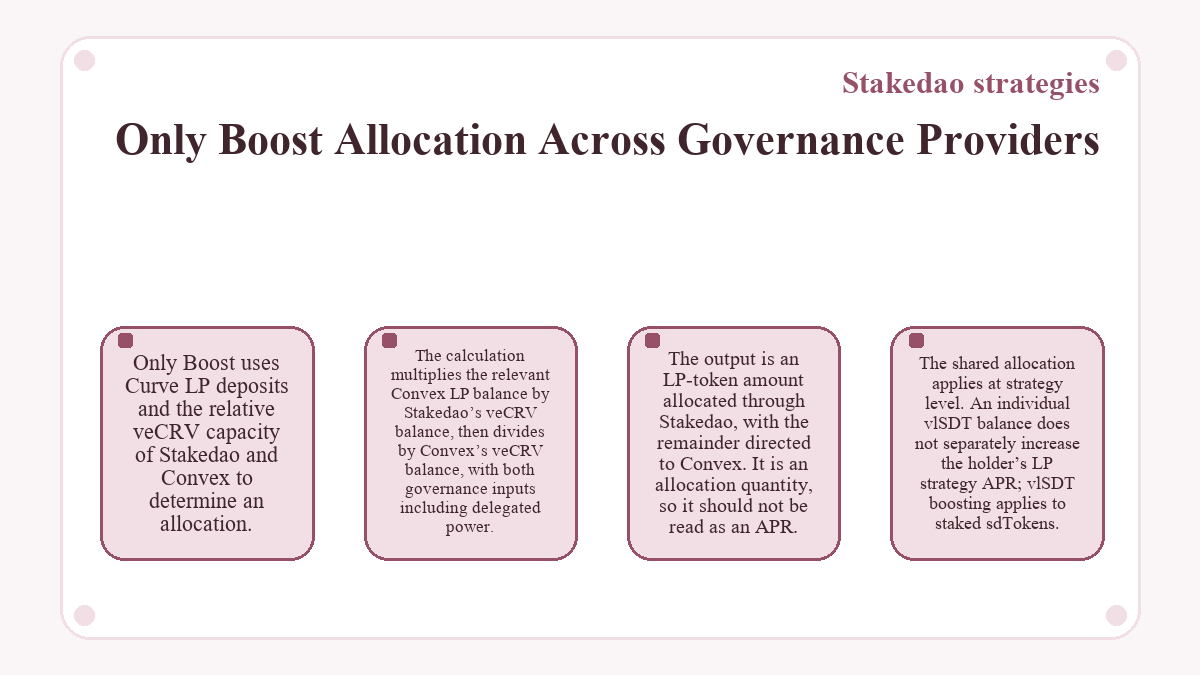
Only Boost uses Curve LP deposits and the relative veCRV capacity of Stakedao and Convex to determine an allocation. The calculation multiplies the relevant Convex LP balance by Stakedao’s veCRV balance, then divides by Convex’s veCRV balance, with both governance inputs including delegated power. The output is an LP-token amount allocated through Stakedao, with the remainder directed to Convex. It is an allocation quantity, so it should not be read as an APR.
The shared allocation applies at strategy level. An individual vlSDT balance does not separately increase the holder’s LP strategy APR; vlSDT boosting applies to staked sdTokens.
Position Selection and Vault Settlement
Direct strategies concentrate exposure in a selected LP position, while Curated Vaults allocate a single-asset deposit across strategies. Their fee schedules and settlement rules belong to different product layers.
Direct LP Exposure
Direct deposits use the strategy’s corresponding LP token. Zap, powered by Enso, can combine conversion and position entry through a supported route. The conversion introduces price impact, slippage settings, and network costs before the strategy’s harvest economics apply. Zap conversion costs remain separate from the strategy’s performance fee.
Curator-Managed Allocation
Curated Vaults auto-compound through allocations chosen by a curator, with fees set per vault by its curator and infrastructure provider. The standard IPOR and Morpho vault flows use direct deposits and withdrawals. Lagoon uses requests: a deposit or redemption remains pending until processing makes the relevant amount mintable or redeemable. A request therefore differs from an immediately settled withdrawal.
Borrowing Costs and Optional Strategy Cover
Selected strategy positions can support borrowing through a non-transferable collateral wrapper while remaining staked and earning rewards. Borrowing adds debt interest and liquidation exposure to the LP position’s economics, with the market determining the loan asset, liquidation threshold, and interest-rate model. Continued reward accrual does not prevent liquidation when falling collateral value or growing debt breaches the market threshold.
Optional OpenCover protection is available for supported strategies on eligible chains, with Nexus Mutual underwriting the cover. Premiums apply to the insured amount, whereas performance fees apply to rewards. The insured strategy, covered protocols, cover start date, and contract terms determine which incidents can qualify for a claim.
Frequently asked questions
Can Anyone Deploy a Stakedao Strategy for an Eligible Pool?
Anyone can deploy a strategy for a supported pool if no corresponding strategy exists and its active gauge has allocated weight. The presence of a liquidity pool alone does not establish that eligibility. Deployment uses the strategy deployment interface, and the resulting strategy relies on the underlying protocol’s gauge and reward allocation.
Does Skipping the Gauge Deposit Remove Every Entry Cost?
Skipping the immediate gauge deposit reduces gas costs while creating a compensation obligation. The next user who deposits to the underlying gauge receives a small portion of the deferred depositor’s balance for performing the additional transaction. This is a specific deposit option, separate from performance fees on harvested rewards.
Why Can a Zap Into a Strategy Revert During Execution?
A Zap can revert when unfavorable price movement exceeds the selected slippage tolerance. The quoted route, price impact, and minimum output describe the conversion into the destination position. A token approval authorizes spending; it does not establish that the Zap executed or that the strategy deposit completed.
Are Extra V2 Strategy Rewards Automatically Compounded?
Extra V2 strategy rewards are distributed to users without automatic compounding. Reinvestment is manual, while Curated Vault auto-compounding describes a separate allocation product.
Can a V2 Strategy Remain Withdrawable During a Protocol Pause?
A V2 protocol pause blocks deposits while allowing withdrawals. A gauge shutdown uses a separate process that moves assets back to the vault for withdrawal.
Why Can a V2 RewardVault Show No LP Tokens Despite Outstanding Shares?
V2 RewardVaults send deposited LP tokens directly to allocation targets. A zero LP-token balance at the vault address can therefore coexist with outstanding shares; vault share balances track the position.
What Happens to Earned Rewards When Strategy Collateral Is Liquidated?
Liquidation stops future rewards on the seized portion of a strategy position, while the borrower retains rewards earned before liquidation. The liquidation process claims those earned rewards on the borrower’s behalf. Liquidation may be total or partial under the lending market’s rules; continued yield does not protect collateral from seizure.
Which Losses Does Optional Strategy Cover Exclude?
Strategy cover excludes ordinary market-price losses, protocol-issued token depegs, phishing, private-key loss, bridge failures, and incidents occurring before cover begins. Oracle manipulation or failure can qualify under its covered-event terms. A valid Nexus Mutual claim also requires membership, KYC, the membership fee, and jurisdictional eligibility, alongside the insured strategy’s cover conditions.