 Stakedao
 - Vote Incentives Versus Boost Rental
Stakedao connects payments for gauge votes with a separate marketplace for renting the weight behind sdToken voting power. Votemarket campaigns reward eligible votes directed toward selected liquidity gauges. The Boost Marketplace lets vlSDT holders sell temporary boost delegations to sdToken holders seeking additional voting weight. A rental can affect the share of voting power attached to an existing sdToken stake. Its cost remains separate from any campaign rewards the resulting votes earn.
Key takeaway: An sdToken holder can rent additional voting weight, while a vlSDT holder earns rental revenue only from filled boost trades.
Campaign Funding and Rental Revenue
Votemarket campaign managers fund incentives to attract votes toward a gauge, the mechanism allocating a protocol’s liquidity rewards. Eligible voters earn campaign incentives for votes directed to the selected gauge. In a boost rental, the sdToken holder becomes the payer and the vlSDT seller receives rental revenue. The buyer pays for temporary delegation capacity, while a campaign compensates the voting contribution qualifying under its terms. Those cash flows can belong to different participants.
Participation Routes and Required Balances
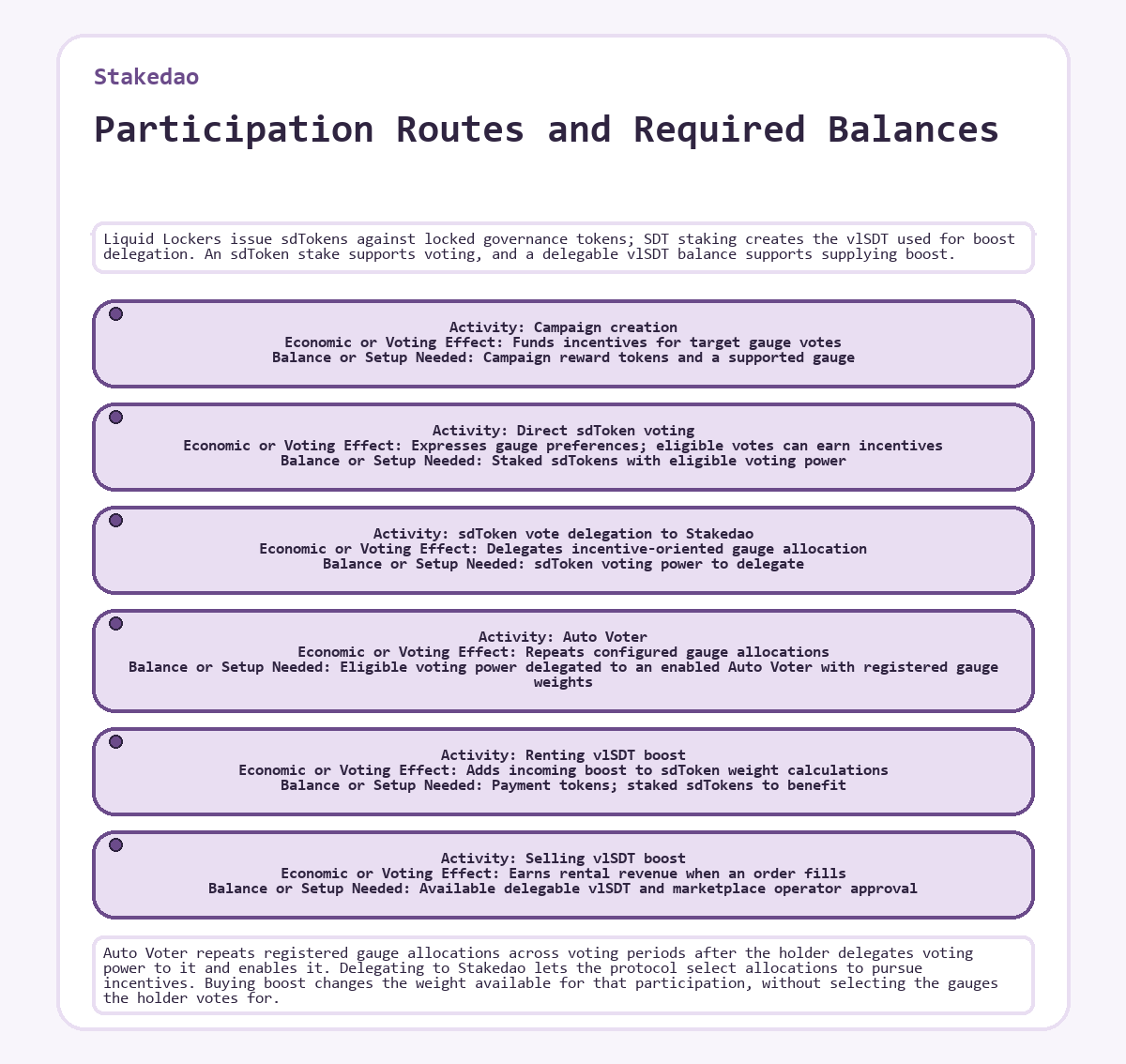
Liquid Lockers issue sdTokens against locked governance tokens; SDT staking creates the vlSDT used for boost delegation. An sdToken stake supports voting, and a delegable vlSDT balance supports supplying boost.
| Activity | Economic or Voting Effect | Balance or Setup Needed |
|---|---|---|
| Campaign creation | Funds incentives for target gauge votes | Campaign reward tokens and a supported gauge |
| Direct sdToken voting | Expresses gauge preferences; eligible votes can earn incentives | Staked sdTokens with eligible voting power |
| sdToken vote delegation to Stakedao | Delegates incentive-oriented gauge allocation | sdToken voting power to delegate |
| Auto Voter | Repeats configured gauge allocations | Eligible voting power delegated to an enabled Auto Voter with registered gauge weights |
| Renting vlSDT boost | Adds incoming boost to sdToken weight calculations | Payment tokens; staked sdTokens to benefit |
| Selling vlSDT boost | Earns rental revenue when an order fills | Available delegable vlSDT and marketplace operator approval |
Auto Voter repeats registered gauge allocations across voting periods after the holder delegates voting power to it and enables it. Delegating to Stakedao lets the protocol select allocations to pursue incentives. Buying boost changes the weight available for that participation, without selecting the gauges the holder votes for.
Rented Weight and the sdToken Balance Cap
Rented boost increases the effective vlSDT input in a staked sdToken position’s weighting calculation, subject to the locker’s balance cap. The holder’s sdToken quantity stays unchanged.
Effective boost starts with the holder’s vlSDT voting balance, subtracts active outgoing boost, and adds incoming delegations. Rental supplies weight without requiring the buyer to accumulate the corresponding SDT stake. Selling delegation reduces the seller’s own effective boost while it remains active.
The Liquid Locker formula starts with 40% of the holder’s staked sdToken balance. It adds a component based on 60% of total staked sdTokens, multiplied by effective boost divided by total vlSDT supply. A holder’s adjusted balance cannot exceed their staked sdToken balance.
The locker allocates its total voting power proportionally across adjusted balances, so each holder’s voting share also depends on the sdToken stakes and effective boost balances of the other participants. Once a position reaches its cap, additional rental adds no adjusted balance while the other formula inputs remain unchanged.
Boost size alone cannot establish an incentive payout. Campaign rewards also depend on eligible votes and the period’s reward budget, with payments per vote capped by the campaign’s maximum. The rental cost must be weighed against the additional campaign rewards the extra voting share could earn. A seller with staked sdTokens also weighs rental revenue against any incentive income lost through a reduced voting share.
Listings, Offers, and Trade Costs
Boost Marketplace sell listings specify an amount, a price per unit of boost per week, a payment token, and maximum duration. Listings reserve seller capacity until filled or cancelled. The reservation prevents the same available balance from supporting commitments beyond the seller’s capacity. Buy offers place payment tokens in escrow while they await acceptance by a seller. A listing or offer records proposed terms; a filled trade creates the actual delegation. Open order status therefore differs from an active incoming boost balance. Partial fills can leave both an active delegation and remaining order capacity.
Marketplace operator approval authorizes the contract to create boost delegations from the seller’s available balance. This permission is separate from the payment-token spending approval used to fund a purchase. An approval alone does not establish an order fill or an active delegation.
Rental payment depends on the filled boost amount, weekly unit price, and purchased duration, while a governance-configured fee, expressed in basis points, reduces the seller’s proceeds from the trade. Campaign rewards do not determine these payment terms.
Does Rented Boost Raise LP Strategy APR?
LP Strategy APR does not increase because a depositor holds or rents additional vlSDT boost for an sdToken position. Strategies use governance power pooled through Liquid Lockers to boost underlying gauge rewards.
Vote Eligibility and Distribution Timing
sdToken vote incentives depend on the gauges selected and the voting power recognized for the relevant period. Vote replication lets Liquid Lockers cast underlying protocol votes proportionally to sdToken holders’ preferences. Gauge allocations direct liquidity incentives, while governance proposals concern decisions within the underlying protocol. Campaign rewards relate to eligible gauge votes. Staked balances feed time-weighted voting calculations, so a wallet balance alone does not describe the voting weight available immediately. Gauge allocations and underlying governance proposals also use different averaging windows.
Distribution follows the underlying protocol’s applicable schedule, which can differ from its voting period. Locker incentive allocation considers the voting power recorded at the period’s end and the incentives earned by the selected gauges. Rental duration and campaign timing therefore need to align with the intended voting participation. For Pendle incentives distributed through Stakedao, voting power must be delegated before the voting period begins.
Delegation Expiry and Legacy Boost
BoostRegistry delegations retain their full amount until expiry, then drop to zero. The registry requires Thursday 00:00 UTC expiry boundaries and permits expiries no more than 52 weeks ahead. Active outgoing delegations also constrain the seller’s unstaking capacity: the maximum is the vlSDT voting balance minus outgoing boost. An eligible unstake request then starts the separate eight-week SDT withdrawal queue.
Legacy veSDT balances no longer provide boost on sdToken vaults. New veSDT locks are disabled. Existing veSDT locks retain their applicable governance voting rights until expiry, and holders can migrate to vlSDT. Old veBoost purchases and sales no longer contribute to sdToken boost accounting. The relevant choice is whether to acquire temporary incoming boost, retain an owned vlSDT stake, or supply unused delegation capacity for rental.
What readers ask about Stakedao
-
Can Renting Boost Transfer Ownership of the seller’s SDT?
- A boost rental supplies temporary boost delegation while the seller retains ownership of the underlying staked SDT. vlSDT itself is non-transferable. The buyer receives incoming boost for the sdToken weighting calculation, and the order amount measures that delegated capacity.
-
Why Can Gauge Votes and Governance Votes Use Different sdToken Voting Weights?
- Gauge allocation votes use a 10-day time-weighted average, while underlying protocol governance votes use a 30-day average. Each calculation reflects the stake history within its own window. Recent changes in a staked sdToken balance can therefore affect the two voting calculations differently, even when the wallet’s current token balance is identical.
-
When Does a Boost seller’s vlSDT Stake Start Earning Protocol Fees?
- vlSDT fee rewards begin with the first full weekly epoch after staking. FeeDistributor uses balances at each epoch’s start, with boundaries on Thursday at 00:00 UTC. Rental income comes from filled boost trades under their own terms. Creating an order does not establish eligibility for an earlier fee epoch.
-
What Happens to Unused Payment Tokens When a Buy Offer Is Cancelled?
- Cancelling a buy offer returns its remaining escrowed payment tokens to the buyer. Partial fills can spend some of the original escrow before cancellation. The refund covers the offer’s unused funds, while payments for already filled boost remain part of the completed trades.
-
How Do Marketplace Payment Limits Protect Buyers and Sellers?
- Buyers filling sell listings can set maxTotalPayment, while sellers accepting buy offers can set minTotalPayment. The first limits the buyer’s total payment; the second rejects an acceptance below the seller’s specified minimum. These controls apply to the boost trade’s settlement. They do not fix future gauge incentives or the value of campaign rewards.
-
In What Token Does Stakedao Distribute Liquid Locker Vote Incentives?
- Stakedao distributes collected Liquid Locker vote incentives in the corresponding sdToken. The distribution process converts the collected campaign rewards through a pool swap or direct minting, depending on the exchange rate. A campaign’s funding token and the asset a locker voter receives can therefore differ.
-
Where Does Votemarket Process Campaigns Tied to Mainnet Votes?
- Votemarket’s Arbitrum deployment uses storage proofs and oracles to verify mainnet voting state. Incentives can therefore be processed on Arbitrum while the underlying gauge votes remain on mainnet.
-
Is an Expired veSDT Lock Eligible for Migration Into the Boost System?
- An expired veSDT lock can migrate to vlSDT, as can an active lock. Migration transfers the full locked SDT amount without applying voting-power decay. The process is one-way. Migration is optional and has no deadline, and old veBoost delegations do not block it.